


How to Make Amaretti Biscuits
Amaretti biscuits are a staple in many Italian homes, but everyone’s recipe is different! This Amaretti recipe has been passed down through generations and is my favourite. Join my mother-in-law, Maria, as she shares her family recipe for these delightful almond bites that are a little crispy on the outside and soft on the inside. Amaretti are great for entertaining – or even gift-giving this festive season.
Amaretti are delicious little bites of heaven. They’re crunchy on the outside, with a soft and chewy centre. And they’re made with just a few simple ingredients – almonds, sugar, egg white and vanilla extract. They also have a gorgeous aroma that fills your kitchen as they bake in the oven. Amaretti are one of my favourite Italian desserts. They are easy to make but require some patience and skill.
The most important thing is to wait until they cool completely before you try one! If you don’t have the time or patience to wait for them to cool, I recommend trying another recipe instead. Amaretti are the perfect accompaniment to espresso or cappuccino. But they’re also great as a snack or after-dinner treat. They’re delicious with ice cream and fresh fruit, too.
Watch Amaretti Biscuits video recipe:
How to Make Gluten Free Almond Amaretti Cookies Like An Italian

Nonna Maria’s Top Tips To Make Amaretti Biscuits
Just add some extra
Add some extra almond meal if the mixture is too wet and sticky.
Dip and Spread
If your hands are getting too sticky to roll the amaretti, get a bowl and place some water inside, dip a finger into it, and spread it to both palms to help smoothen the process.
Use parchment paper
Line your baking sheets with parchment paper to prevent the amaretti biscuits from sticking and to make for easier cleanup.
Let them cool completely.
After baking, let the amaretti biscuits cool completely on the baking sheet before removing them. This will help them to set and become crispy.
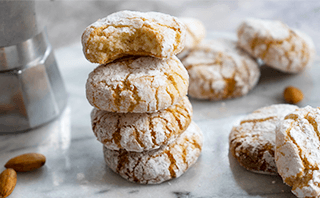
Amaretti Biscuits
 Print Recipe
Equipment
- Large mixing bowl
- Medium mixing bowl
- Whisk
- Teaspoon
- Baking Tray
- Baking Paper
Ingredients
- 500 grams Almond Meal, 5.2 cups
- 300 grams Caster sugar, 1.33 cup
- 5 Egg whites, Use free range eggs that are room temperature
- 1 bottle Almond essence, 1.07 Oz
- Bowl of icing sugar, plus extra for dusting!
Instructions
- To start making your Italian amaretti biscuits, separate 5 egg whites from the yolk into a medium mixing bowl and whisk them well.
- Once there are lots of bubbles at the top of the egg whites, add the almond essence and whisk gently once again so it completely infuses them.
- Mix the almond meal and caster sugar together in a separate bowl until the sugar seems to disappear.
- Next for your amaretti biscotti, pour the egg white mixture into the bowl with the dry ingredients and mix through using a large spoon.
- Once this has all started to bind, use your hands to combine everything even more and make sure that everything mixes really well together, still keeping it all inside the large bowl.
- Don’t try and make it into a ball, just squeeze down with your hands so it stays ???
- Now you can let the amaretti mixture rest for an hour (or overnight in the fridge).
- If you’re making them on the same day, wash your hands, and once this has had time to rest, get ready to roll!
- When it’s time to make the amaretti biscotti, prepare a large flat baking tray by spreading baking paper on top and pre-heat your oven to 180 degrees celcius/356 F.
- Using a tea spoon, scoop up a heaped amount of mixture, roll it around using the palm of your hand, and make it into a ball.
- Place the ball gently into a bowl of icing sugar and repeat until the bowl is almost full.
- Roll each amaretti ball around in icing sugar and then gently place it on the baking tray.
- Line the balls up, making sure you don’t place them too close together.
- Once the tray is completely full, with enough space in between each one, flatten out your hand, and press down gently onto each ball making the surface flat. This will create some cracks and provide the perfect form for your amaretti biscotti!
- Dust with one more sprinkle of icing sugar all over before placing them in the oven for approx. 15 minutes – but check them after about 12 minutes as all ovens vary!
- E ora si mangia, Vincenzo’s Plate….Enjoy!
Video
Vincenzo’s Version – Quicker, Flexible, and a Little Different
Nonna Maria’s recipe is the one I always come back to – and if you have been making it for years and love the result, stay exactly where you are. But if you want to try a slightly different approach, here is what I do now.
A few things have changed in my version. The flavour is different. The texture is slightly different. Some of the steps are quicker. None of these changes make one version better than the other – they just make them different. Read through the notes below, watch the video, and decide which suits you.
Watch: How to Make Vincenzo’s Amaretti Biscuits
Want to Try a Different Flour?
Almond meal is the classic choice and what Nonna Maria uses. In my version, I sometimes swap it for hazelnut flour or pistachio flour. Both work beautifully but they do change the flavour noticeably – hazelnut gives a richer, nuttier result, and pistachio adds a subtle sweetness and a beautiful colour. If you try one of these alternatives, keep everything else in the recipe the same. Just be aware the result will taste different from the original – not better or worse, just different.
Vanilla Extract or Almond Essence?
Nonna Maria uses almond essence, which gives the biscuits that classic, intense almond flavour most people associate with amaretti. In my version I use vanilla extract instead, which produces a softer, more rounded flavour with less of that sharp almond hit. Neither is wrong – it simply depends on whether you want the traditional almond intensity or something a little gentler. If this is your first time making amaretti, try Nonna Maria’s almond essence version first so you know what the original tastes like before experimenting.

Adding Icing Sugar to the Egg Whites
In my version, I add a small amount of icing sugar to the egg whites while whisking to create a light meringue base before folding in the dry ingredients. This is not in Nonna Maria’s original method. It creates a slightly different texture – a little lighter and airier in the centre – and gives the biscuits a delicate shine on the outside. If you prefer the texture of the original, skip this step entirely and follow Nonna Maria’s method. Both approaches produce beautiful biscuits.
To Rest or Not to Rest?
Nonna Maria’s recipe includes a one-hour resting time after combining the egg whites and dry ingredients, and the mixture is not formed into a ball during this step. That rest is what gives the original its lighter, crispier texture. In my version I skip the rest and form the mixture into balls straight away. It is quicker and more convenient, but the result is a slightly chewier, denser biscuit. If time allows, the rest is worth it for the texture. If you are short on time, skipping it still gives you a delicious result – just a different one.

Frequently Asked Questions
What is the difference between Nonna Maria’s amaretti and Vincenzo’s version?
Nonna Maria’s recipe is the classic family method – almond meal, almond essence, a one-hour resting time, and no dough ball formed before resting. The result is a lighter, crispier biscuit with that traditional, intense almond flavour. Vincenzo’s version uses vanilla extract instead of almond essence, adds icing sugar to the egg whites to create a meringue base, skips the resting time, and forms the mixture into balls straight away. The result is slightly chewier and denser, with a softer, more rounded flavour. Both are gluten free and delicious – the choice depends on whether you want the traditional result or a quicker, slightly different version. If in doubt, start with Nonna Maria’s method.
Are amaretti biscuits gluten free?
Yes – amaretti biscuits are naturally gluten free. The recipe uses almond meal, egg whites and sugar, none of which contain gluten. There is no flour of any kind in this recipe. If you are baking for someone with coeliac disease or a gluten intolerance, just check that your almond meal is certified gluten free, as some brands are processed in facilities that also handle wheat.
What is the difference between soft and crunchy amaretti?
Amaretti come in two styles – soft (amaretti morbidi) and crunchy (amaretti secchi). Soft amaretti are baked for a shorter time at a lower temperature, giving them a chewy, almost marzipan-like centre with a light crust on the outside. Crunchy amaretti are baked longer until completely dry throughout – these are the style you often find in the paper-wrapped packets at Italian cafes and used crushed in desserts. Nonna Maria’s recipe produces the soft style – crispy on the outside and soft and chewy in the centre – which is the version most home bakers prefer.
How long do amaretti biscuits keep?
Amaretti biscuits keep beautifully for up to two weeks stored in an airtight container at room temperature. In fact they often taste even better after a day or two as the flavours deepen and the texture settles. Keep them away from moisture and humidity, which can soften the outside crust. They also make a wonderful homemade gift – pack them into a tin or a glass jar tied with ribbon and they will keep perfectly for the recipient to enjoy over the following week.
Can amaretti biscuits be frozen?
Yes – amaretti biscuits freeze very well. Once completely cooled after baking, place them in an airtight container or freezer bag and freeze for up to two months. Thaw at room temperature for about 30 minutes before serving. The texture holds up beautifully and they taste just as good as freshly baked. This makes amaretti an excellent recipe to batch bake ahead of time for Christmas, dinner parties or gifts.
What can I do with leftover egg yolks from this recipe?
This recipe uses only egg whites, which means you will have egg yolks left over. The best thing you can do with them is make zabaglione – a classic Italian custard dessert made with egg yolks, sugar and a splash of Frangelico. It is silky, elegant and ready in about 15 minutes. Vincenzo’s zabaglione recipe on this site uses Bis-Nonno Tobia’s family method and is the perfect pairing with amaretti biscuits – serve them alongside each other for a beautifully Italian dessert course.
What can I make with amaretti biscuits?
Amaretti biscuits are incredibly versatile. They are delicious on their own with an espresso or a small glass of dessert wine, but they also work beautifully in desserts. Crush them and use them as a base layer in tiramisu instead of savoiardi biscuits for a nuttier, more intense flavour. Crumble them over vanilla gelato or panna cotta for texture and crunch. Use them crushed in the filling of baked peaches – a classic Italian summer dessert where the biscuit replaces the fruit stone with sweetness and almond flavour. They also make one of the most thoughtful and beautiful homemade gifts you can give, especially at Christmas.
Why are my amaretti biscuits not cracking on top?
The classic cracked top on amaretti comes from the contrast between the dry outer crust that sets in the oven and the soft interior that continues to expand slightly as it bakes. If your amaretti are not cracking, there are a few common reasons. The mixture may be too wet – if your egg whites were very large or slightly overwhipped, the dough can be too loose to hold its shape and crack properly. The oven temperature may be too low – make sure your oven is fully preheated before the biscuits go in. Rolling the balls in icing sugar before baking also helps create those beautiful cracks as the sugar coating sets against the expanding dough. Finally, make sure you are not overloading the tray – give each biscuit enough space so the heat can circulate around them evenly
How to serve Amaretti Biscuits
Leave the amaretti to cool, or enjoy it nice and warm with a cup of tea, coffee or hot cocoa!
Subscribe to my Youtube Channel: www.youtube.com/vincenzosplate




Leave a Reply